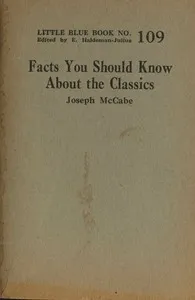
Facts you should know about the classics
- Language
- EN
- Format
- EPUB
- Size
- 290 KB
Description
Facts you should know about the classics by Joseph McCabe is a concise nonfiction literary guide written in the early 20th century. It surveys the enduring “classics” of world literature, outlining what they are, who wrote them, and why they matter.
The book moves chronologically. It opens with sacred and early texts (Egyptian funerary writings, the Epic of Gilgamesh, the Hebrew Bible, the Avesta, the Vedas, and the Chinese classics), then turns to Greece—the fountainhead of Western literature—highlighting epic (Homer), lyric, tragedy (Aeschylus, Sophocles, Euripides), comedy (Aristophanes), history (Herodotus, Thucydides), oratory (Demosthenes), and philosophy (Plato, Aristotle). Rome follows with its Golden Age poets and prose (Vergil, Horace, Ovid, Lucretius, Catullus; Cicero, Livy, Tacitus), moralists (Seneca, Marcus Aurelius), and satirists (Juvenal, Martial). Early Christian letters are distilled to Augustine’s Confessions and City of God. The Middle Ages revive through Persian and Arab masterpieces (Omar Khayyam, the Arabian Nights) and Europe’s reawakening in Dante, then Petrarch, Boccaccio, Froissart, and Chaucer. The Renaissance and after bring Machiavelli, Cellini, Ariosto, Tasso, Erasmus, Rabelais, Montaigne, and French classicism (Corneille, Racine, Molière; La Fontaine; Pascal; Montesquieu), alongside Spain’s Cervantes. England’s rebirth runs from Malory and More to Spenser, Marlowe, Shakespeare, Milton, Bunyan, and Dryden. The modern period surveys French luminaries (Voltaire, Rousseau, Hugo, Dumas, Balzac, Flaubert, Baudelaire, Maupassant, Zola), German masters (Goethe, Schiller, Heine, Nietzsche), Scandinavians (Ibsen, Björnson), Russians (Pushkin, Gogol, Turgenev, Dostoevsky, Tolstoy, Chekhov), and a sweep of English and American writers from Pope, Defoe, Swift, Scott, Dickens, and the Romantic poets to Emerson, Whitman, Hawthorne, and Twain. Throughout, McCabe offers brisk portraits, critical judgments, and occasional reading tips, giving general readers a compact map of world classics.
The book moves chronologically. It opens with sacred and early texts (Egyptian funerary writings, the Epic of Gilgamesh, the Hebrew Bible, the Avesta, the Vedas, and the Chinese classics), then turns to Greece—the fountainhead of Western literature—highlighting epic (Homer), lyric, tragedy (Aeschylus, Sophocles, Euripides), comedy (Aristophanes), history (Herodotus, Thucydides), oratory (Demosthenes), and philosophy (Plato, Aristotle). Rome follows with its Golden Age poets and prose (Vergil, Horace, Ovid, Lucretius, Catullus; Cicero, Livy, Tacitus), moralists (Seneca, Marcus Aurelius), and satirists (Juvenal, Martial). Early Christian letters are distilled to Augustine’s Confessions and City of God. The Middle Ages revive through Persian and Arab masterpieces (Omar Khayyam, the Arabian Nights) and Europe’s reawakening in Dante, then Petrarch, Boccaccio, Froissart, and Chaucer. The Renaissance and after bring Machiavelli, Cellini, Ariosto, Tasso, Erasmus, Rabelais, Montaigne, and French classicism (Corneille, Racine, Molière; La Fontaine; Pascal; Montesquieu), alongside Spain’s Cervantes. England’s rebirth runs from Malory and More to Spenser, Marlowe, Shakespeare, Milton, Bunyan, and Dryden. The modern period surveys French luminaries (Voltaire, Rousseau, Hugo, Dumas, Balzac, Flaubert, Baudelaire, Maupassant, Zola), German masters (Goethe, Schiller, Heine, Nietzsche), Scandinavians (Ibsen, Björnson), Russians (Pushkin, Gogol, Turgenev, Dostoevsky, Tolstoy, Chekhov), and a sweep of English and American writers from Pope, Defoe, Swift, Scott, Dickens, and the Romantic poets to Emerson, Whitman, Hawthorne, and Twain. Throughout, McCabe offers brisk portraits, critical judgments, and occasional reading tips, giving general readers a compact map of world classics.
Ask about this book
An AI guide answers your questions about this title
FAQ
Is "Facts you should know about the classics" free to download?
Yes, it is free to download — no sign up needed.
What format is the file?
EPUB.
More by Joseph McCabe


Reader reviews Be the first
No reviews yet. Be the first to review this book.
Write a review
Protected by reCAPTCHA.