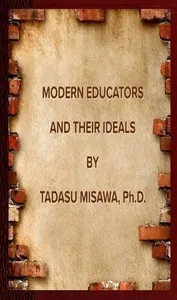
Modern educators and their ideals
- Language
- EN
- Format
- EPUB
- Size
- 648 KB
Description
"Modern educators and their ideals" by Tadasu Misawa is a scholarly survey of educational philosophy written in the early 20th century. It outlines the ideals and methods of major reformers and philosophers to guide students of pedagogy, teachers, and interested parents, presenting their key ideas through concise exposition and curated excerpts.
The opening of the book sets its purpose: to summarize influential modern educators sympathetically, avoid heavy criticism, and provide accessible bibliographies. The introduction traces the lineage of Western educational ideals from Greece and Rome through Christianity and the Middle Ages to the Renaissance and Reformation, highlighting Luther’s democratic push for universal, practical schooling and Bacon’s call for empiricism. The first chapter on Comenius blends Reformation piety with realistic method, advocating universal, early, sense-based, and systematically graded schooling centered on the vernacular and practical aims. The next chapter contrasts Locke’s pragmatic, gentlemanly education: health and habit first, character before book learning, gentle discipline grounded in esteem rather than the rod, rich but practical studies, and a preference for a good tutor and home over crowded schools. The beginning of the Rousseau chapter pivots to a “return to Nature,” insisting that children be allowed to be children, that instruction be delayed until readiness, that learning come from things rather than words, and that education follow distinct developmental stages under the joint influences of nature, men, and circumstances. (This is an automatically generated summary.)
The opening of the book sets its purpose: to summarize influential modern educators sympathetically, avoid heavy criticism, and provide accessible bibliographies. The introduction traces the lineage of Western educational ideals from Greece and Rome through Christianity and the Middle Ages to the Renaissance and Reformation, highlighting Luther’s democratic push for universal, practical schooling and Bacon’s call for empiricism. The first chapter on Comenius blends Reformation piety with realistic method, advocating universal, early, sense-based, and systematically graded schooling centered on the vernacular and practical aims. The next chapter contrasts Locke’s pragmatic, gentlemanly education: health and habit first, character before book learning, gentle discipline grounded in esteem rather than the rod, rich but practical studies, and a preference for a good tutor and home over crowded schools. The beginning of the Rousseau chapter pivots to a “return to Nature,” insisting that children be allowed to be children, that instruction be delayed until readiness, that learning come from things rather than words, and that education follow distinct developmental stages under the joint influences of nature, men, and circumstances. (This is an automatically generated summary.)
FAQ
Is "Modern educators and their ideals" free to download?
Yes, it is free to download — no sign up needed.
What format is the file?
EPUB.
Similar books
Reader reviews Be the first
No reviews yet. Be the first to review this book.
Write a review
Protected by reCAPTCHA.