
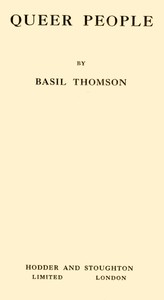
Queer people
- Language
- EN
- Format
- EPUB
- Size
- 1.5 MB
Description
"Queer people" by Basil Thomson is a memoir of policing and intelligence written in the early 20th century. It offers an insider’s account of Scotland Yard and the Special Branch, showing how organization, legwork, and luck—not fanciful forensics—solve real cases, and how war fever and rumor can hinder sound judgment. Expect lively true-crime and espionage anecdotes: jewel thefts, confidence tricks, spy scares, political violence, and the everyday craft of detectives and “thief-catchers.”
The opening of this work moves from a brief, modest preface into a brisk demystification of detective fiction, as the narrator contrasts Sherlockian showmanship with the Yard’s methodical systems and field craft. He sketches the CID’s structure, praises “thief-catchers,” and illustrates practical ingenuity with sharp vignettes (baiting bus pickpockets, posing as a gardener, outwitting suspects in shops and on the Tube). The next chapter exposes “adolescent lying” through cases of forged poison-pen letters and a fanciful maid’s fake kidnapping and spy yarn, followed by the famous recovery of a stolen pearl necklace and raids on receivers and safe-breakers. A survey of classic swindles follows—the Spanish Prisoner letters, the American “confidence trick,” a man who “stole a row of houses,” and a bogus doctor who robs patients he pretends to examine. At the start of the war narrative, he recalls the swift neutralization of a German spy network, smooth mobilization, and then a rolling catalogue of public hysteria—Russians “seen” in Britain, pigeon and wireless scares, gun-platform myths, coded agony columns, and imagined night signals—each patiently investigated and debunked. Finally, the early Special Branch chapters trace its evolution from anarchists and suffragettes to wartime duties, note crime’s decline as offenders enlisted (including a V.C. winner), and offer quick, human portraits from the flood of letters, tourists, refugees, internment at Olympia, and the everyday oddities that crowded the first months of war. (This is an automatically generated summary.)
The opening of this work moves from a brief, modest preface into a brisk demystification of detective fiction, as the narrator contrasts Sherlockian showmanship with the Yard’s methodical systems and field craft. He sketches the CID’s structure, praises “thief-catchers,” and illustrates practical ingenuity with sharp vignettes (baiting bus pickpockets, posing as a gardener, outwitting suspects in shops and on the Tube). The next chapter exposes “adolescent lying” through cases of forged poison-pen letters and a fanciful maid’s fake kidnapping and spy yarn, followed by the famous recovery of a stolen pearl necklace and raids on receivers and safe-breakers. A survey of classic swindles follows—the Spanish Prisoner letters, the American “confidence trick,” a man who “stole a row of houses,” and a bogus doctor who robs patients he pretends to examine. At the start of the war narrative, he recalls the swift neutralization of a German spy network, smooth mobilization, and then a rolling catalogue of public hysteria—Russians “seen” in Britain, pigeon and wireless scares, gun-platform myths, coded agony columns, and imagined night signals—each patiently investigated and debunked. Finally, the early Special Branch chapters trace its evolution from anarchists and suffragettes to wartime duties, note crime’s decline as offenders enlisted (including a V.C. winner), and offer quick, human portraits from the flood of letters, tourists, refugees, internment at Olympia, and the everyday oddities that crowded the first months of war. (This is an automatically generated summary.)
FAQ
Is "Queer people" free to download?
Yes, it is free to download — no sign up needed.
What format is the file?
EPUB.
More by Basil Thomson
Similar books

Reader reviews Be the first
No reviews yet. Be the first to review this book.
Write a review
Protected by reCAPTCHA.