
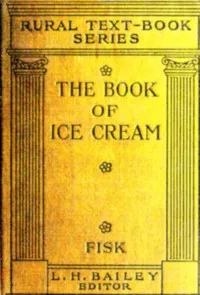
The book of ice-cream
- Language
- EN
- Format
- EPUB
- Size
- 11 MB
Description
"The book of ice-cream" by W. W. Fisk is a technical textbook written in the early 20th century. It explains the science and practice of making ice-cream and related ices at commercial and advanced home scales, detailing ingredients, formulations, equipment, refrigeration, sanitation, quality testing, and business management. Aimed at students, manufacturers, and housekeepers, it focuses on achieving consistent flavor, texture, and safety through standardized, evidence-based methods.
The opening of this volume repositions ice-cream from rare treat to everyday food, explains the rise of industrial production and specialized machinery, and states the book’s dual purpose for classroom/laboratory use and practical manufacturing, with extensive acknowledgments. A detailed contents outline previews chapters on ingredients, classification, equipment, refrigeration, mixing, freezing, hardening, judging, bacteriology, testing, marketing, plant design, and history. The first chapters define ice-cream, list core components (dairy bases, sugars, flavors, colors, stabilizers), compare official standards, and argue for clearer definitions and bacterial controls while framing ice-cream-making as a science. They then examine milk and cream: sourcing models and their trade-offs; desired qualities (sweet, pasteurized, aged, homogenized); causes of off-flavors (feed, ambient odors, cow health); bacterial risks, sediment testing, rapid cooling practices, clarifiers, and composition/standards, with buying and standardizing by fat test. Next comes manufactured inputs: how condensed/evaporated milk is made and specified, what a condensory requires, why most makers buy rather than produce; milk powders (Merrell-Soule and Ekenberg processes, their history, and uses for standardizing mixes or creating cream with butter); and butter selection/storage. The section concludes by introducing sweeteners and sugar-saving substitutes (invert sugar, corn syrup), and surveying cocoa/chocolate sources, processing, composition, purity standards, and a practical chocolate syrup formula.
The opening of this volume repositions ice-cream from rare treat to everyday food, explains the rise of industrial production and specialized machinery, and states the book’s dual purpose for classroom/laboratory use and practical manufacturing, with extensive acknowledgments. A detailed contents outline previews chapters on ingredients, classification, equipment, refrigeration, mixing, freezing, hardening, judging, bacteriology, testing, marketing, plant design, and history. The first chapters define ice-cream, list core components (dairy bases, sugars, flavors, colors, stabilizers), compare official standards, and argue for clearer definitions and bacterial controls while framing ice-cream-making as a science. They then examine milk and cream: sourcing models and their trade-offs; desired qualities (sweet, pasteurized, aged, homogenized); causes of off-flavors (feed, ambient odors, cow health); bacterial risks, sediment testing, rapid cooling practices, clarifiers, and composition/standards, with buying and standardizing by fat test. Next comes manufactured inputs: how condensed/evaporated milk is made and specified, what a condensory requires, why most makers buy rather than produce; milk powders (Merrell-Soule and Ekenberg processes, their history, and uses for standardizing mixes or creating cream with butter); and butter selection/storage. The section concludes by introducing sweeteners and sugar-saving substitutes (invert sugar, corn syrup), and surveying cocoa/chocolate sources, processing, composition, purity standards, and a practical chocolate syrup formula.
Ask about this book
An AI guide answers your questions about this title
FAQ
Is "The book of ice-cream" free to download?
Yes, it is free to download — no sign up needed.
What format is the file?
EPUB.
More by W. W. (Walter Warner) Fisk
Reader reviews Be the first
No reviews yet. Be the first to review this book.
Write a review
Protected by reCAPTCHA.