
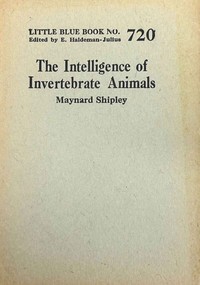
The intelligence of invertebrate animals
- Language
- EN
- Format
- EPUB
- Size
- 319 KB
Description
The intelligence of invertebrate animals by Maynard Shipley is a popular scientific publication from the early 20th century. It examines whether and how mind, learning, and problem-solving appear in animals without backbones, weighing instinct against intelligence and using experiments to argue that many invertebrates can learn from experience.
The book begins by defining intelligence as the ability to form associations and profit from experience, then contrasts this view with claims that invertebrate behavior is purely instinctive or reflexive. It surveys evidence across groups: earthworms that choose and learn routes and fit materials to burrow openings; starfish and sea-anemones showing plastic but debated behaviors; mollusks like oysters and snails that adapt through experience; and octopi that quickly learn to avoid stings and outwit crabs. Among crustaceans, hermit crabs select and transport protective sea-anemones, show color discrimination, and display homing and cooperation, while horseshoe crabs collaborate to right a stranded mate. Spiders exhibit intricate web engineering guided by touch, rapid prey-routing on webs, camouflage, and nest construction, suggesting more than fixed reflexes. Insects provide the richest cases: burying beetles enlist help to inter large carcasses; solitary wasps use pebbles as tools and paralyze prey with surgical precision; bees show focused foraging, partial color-blindness coupled with ultraviolet vision, learned homing, and communicative dances; ants display complex social organization, mutual aid, food-sharing, engineering, agriculture, animal domestication, and tactile “language”; and termites build colossal communal nests with castes. The conclusion rejects the reflex-machine view, arguing that many invertebrates—especially social insects—demonstrate memory, learning, flexibility, and emotions, and that animal mind forms a continuous evolutionary spectrum with our own. (This is an automatically generated summary.)
The book begins by defining intelligence as the ability to form associations and profit from experience, then contrasts this view with claims that invertebrate behavior is purely instinctive or reflexive. It surveys evidence across groups: earthworms that choose and learn routes and fit materials to burrow openings; starfish and sea-anemones showing plastic but debated behaviors; mollusks like oysters and snails that adapt through experience; and octopi that quickly learn to avoid stings and outwit crabs. Among crustaceans, hermit crabs select and transport protective sea-anemones, show color discrimination, and display homing and cooperation, while horseshoe crabs collaborate to right a stranded mate. Spiders exhibit intricate web engineering guided by touch, rapid prey-routing on webs, camouflage, and nest construction, suggesting more than fixed reflexes. Insects provide the richest cases: burying beetles enlist help to inter large carcasses; solitary wasps use pebbles as tools and paralyze prey with surgical precision; bees show focused foraging, partial color-blindness coupled with ultraviolet vision, learned homing, and communicative dances; ants display complex social organization, mutual aid, food-sharing, engineering, agriculture, animal domestication, and tactile “language”; and termites build colossal communal nests with castes. The conclusion rejects the reflex-machine view, arguing that many invertebrates—especially social insects—demonstrate memory, learning, flexibility, and emotions, and that animal mind forms a continuous evolutionary spectrum with our own. (This is an automatically generated summary.)
FAQ
Is "The intelligence of invertebrate animals" free to download?
Yes, it is free to download — no sign up needed.
What format is the file?
EPUB.
Reader reviews Be the first
No reviews yet. Be the first to review this book.
Write a review
Protected by reCAPTCHA.