
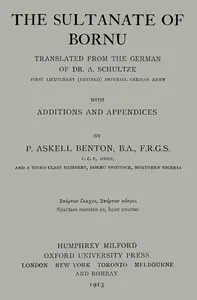
The Sultanate of Bornu
- Language
- EN
- Format
- EPUB
- Size
- 1.9 MB
Description
The Sultanate of Bornu by Arnold Schultze is a historical and ethnogeographical monograph written in the early 20th century. It assembles prior scholarship and field observations to trace the rise, transformation, and colonial-era reconfiguration of the Bornu Empire around Lake Chad, while surveying its landscape, climate, flora, fauna, peoples, and commerce.
The opening of the study begins with a translator’s preface that explains the painstaking English rendering from German, stresses Bornu’s former preeminence in Central Africa, and challenges common misconceptions about Hausa influence and language in Kanuri lands, before noting maps, added appendices, and acknowledgments. The author’s preface states the aim: to produce a compact monograph synthesizing scattered literature with the author’s own observations from boundary work, aided by specialists. The Introduction frames Bornu’s importance through early European exploration (notably German scholars such as Barth and Nachtigal), the exposure of the slave trade, and the later partition by European powers. The History section then sketches Bornu’s origins within Kanem, the Sef dynasty’s Islamic turn and imperial expansion, the shift south after conflicts with Bulala, statecraft under figures like Edriss Aloma, the Fulani pressure and 1809 crisis, and the rise of Mohammed al-Kanemi and Kukawa as a new center. It briskly recounts 19th‑century expeditions (Denham, Clapperton, Barth, Overweg, Vogel, Rohlfs, Nachtigal), the weakening under Shehu Omar, the catastrophic advent of Rabeh from the Nile-Sudan, the fall of Kukawa, Dikoa’s ascent, and the French campaigns culminating in Rabeh’s death and the installation of a new sultan amid Anglo‑French‑German partition. The work then outlines Bornu’s geography: a vast, low alluvial plain rimmed by granite highlands (Zinder–Munio and Mandara), the dynamics of Lake Chad and its shifting islands and dunes, and the hydrology of the Shari–Logone system with seasonal inundations and distinctive firki clays, along with the Yedseram and Komadugu‑Yobe. The climate chapter begins with notes on temperature records and measurement limits before the excerpt ends. (This is an automatically generated summary.)
The opening of the study begins with a translator’s preface that explains the painstaking English rendering from German, stresses Bornu’s former preeminence in Central Africa, and challenges common misconceptions about Hausa influence and language in Kanuri lands, before noting maps, added appendices, and acknowledgments. The author’s preface states the aim: to produce a compact monograph synthesizing scattered literature with the author’s own observations from boundary work, aided by specialists. The Introduction frames Bornu’s importance through early European exploration (notably German scholars such as Barth and Nachtigal), the exposure of the slave trade, and the later partition by European powers. The History section then sketches Bornu’s origins within Kanem, the Sef dynasty’s Islamic turn and imperial expansion, the shift south after conflicts with Bulala, statecraft under figures like Edriss Aloma, the Fulani pressure and 1809 crisis, and the rise of Mohammed al-Kanemi and Kukawa as a new center. It briskly recounts 19th‑century expeditions (Denham, Clapperton, Barth, Overweg, Vogel, Rohlfs, Nachtigal), the weakening under Shehu Omar, the catastrophic advent of Rabeh from the Nile-Sudan, the fall of Kukawa, Dikoa’s ascent, and the French campaigns culminating in Rabeh’s death and the installation of a new sultan amid Anglo‑French‑German partition. The work then outlines Bornu’s geography: a vast, low alluvial plain rimmed by granite highlands (Zinder–Munio and Mandara), the dynamics of Lake Chad and its shifting islands and dunes, and the hydrology of the Shari–Logone system with seasonal inundations and distinctive firki clays, along with the Yedseram and Komadugu‑Yobe. The climate chapter begins with notes on temperature records and measurement limits before the excerpt ends. (This is an automatically generated summary.)
FAQ
Is "The Sultanate of Bornu" free to download?
Yes, it is free to download — no sign up needed.
What format is the file?
EPUB.
Reader reviews Be the first
No reviews yet. Be the first to review this book.
Write a review
Protected by reCAPTCHA.