
Your download link has expired — please click the download button again.
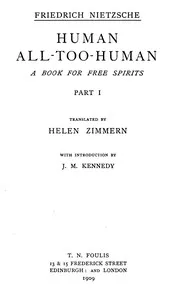
Human, All-Too-Human: A Book for Free Spirits, Part 1: Complete Works, Volume Six
by Friedrich Wilhelm Nietzsche
- Language
- EN
- Format
- EPUB
- Size
- 282 KB
Description
Friedrich Wilhelm Nietzsche's "Human, All-Too-Human: A Book for Free Spirits, Part 1" was published in 1878 as part of his philosophical writings that marked a shift from his earlier style. Comprising 638 aphorisms, the work examines topics including metaphysics, morality, and religious life through concise and provocative statements. Written during a period following his separation from Richard Wagner and originally dedicated to Voltaire, the book reflects Nietzsche's engagement with French Enlightenment ideas and his move away from romanticism. Its aphorisms display a tone of cynicism and historical awareness, challenging traditional Christian morality and foreshadowing themes found in his later philosophy. The work signals a stylistic departure from essays to short, incisive reflections, balancing wit with philosophical critique.
The book is part of the author's broader effort to scrutinise moral values and religious doctrines, adopting a more sceptical and often satirical perspective. It situates itself within 19th-century European philosophical discourse, reflecting Nietzsche’s evolving thought during this period of personal and intellectual change.
The book is part of the author's broader effort to scrutinise moral values and religious doctrines, adopting a more sceptical and often satirical perspective. It situates itself within 19th-century European philosophical discourse, reflecting Nietzsche’s evolving thought during this period of personal and intellectual change.
From the opening pages
Nietzsche's essay, Richard Wagner in Bayreuth, appeared in 1876, and his next publication was his present work, which was issued in 1878. A comparison of the books will show that the two years of meditation intervening had brought about a great change in Nietzsche's views, his style of expressing them, and the form in which they were cast. The Dionysian, overflowing with life, gives way to an Apollonian thinker with a touch of pessimism. The long essay form is abandoned, and instead we have a series of aphorisms, some tinged with melancholy, others with satire, several, especially towards the end, with Nietzschian wit at its best, and a few at the beginning so very abstruse as to require careful study. Since the Bayreuth festivals of 1876, Nietzsche had gradually come to see Wagner as he really was. The ideal musician that Nietzsche had pictured in his own mind turned out to be nothing more than a rather dilettante philosopher, an opportunistic decadent with a suspicious tendency towards Christianity. The young philosopher thereupon proceeded to shake off the influence which the musician had exercised upon him. He was successful in doing so, but not without a struggle, just as he had formerly shaken off the influence of Schopenhauer. Hence he writes in his autobiography: [1] " Human, all-too-Human, is the monument of a crisis. It is entitled: 'A book for free spirits,' and almost every line in it represents a victory—in its pages I freed myself from everything foreign to my real nature. Idealism is foreign to me: the title says, 'Where you see ideal things, I see things which are only—human alas! all-too-human!' I know man better —the term 'free spirit' must here be understood in no other sense than this: a freed man, who has once more taken possession of himself." The form of this book will be better understood when it is remembered that at this period Nietzsche was beginning to suffer from stomach trouble and headaches. As a cure for his complaints, he spent his time in travel when he could get a few weeks' respite from his duties at Basel University; and it was in the course of his solitary walks and hill-climbing tours that the majority of these thoughts occurred to him and were jotted down there and then. A few of them, however, date further back, as he tells us in the preface to…
FAQ
Is "Human, All-Too-Human: A Book for Free Spirits, Part 1: Complete Works, Volume Six" free to download?
Yes, it is free to download — no sign up needed.
What format is the file?
EPUB.
More by Friedrich Wilhelm Nietzsche


Similar books




Reader reviews Be the first
No reviews yet. Be the first to review this book.
Write a review
Protected by reCAPTCHA.