
Your download link has expired — please click the download button again.
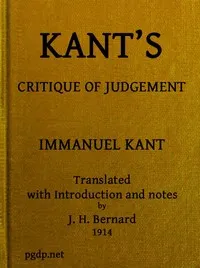
Kant's Critique of Judgement
- Language
- EN
- Format
- EPUB
- Size
- 473 KB
Description
Kant's Critique of Judgement, published in 1790, is a philosophical work that examines the processes by which humans make aesthetic and teleological judgments. The text is the third part of Kant’s critical trilogy and serves to connect his investigations into knowledge and morality by focusing on the faculty of judgment. It analyses how judgments about beauty, the sublime, and purpose in nature are formed, highlighting the concept of "subjective universal" judgments, which maintain validity beyond individual preferences yet resist definitive determination. The work discusses the formal principles underlying aesthetic experience and the idea that judgments of taste involve a subjective universal validity. It also explores how we perceive purposiveness in nature and the manner in which aesthetic responses are both personal and universally communicable.
The work is situated within the context of late 18th-century philosophy, engaging with Kant’s broader critical project. It addresses the role of aesthetic and teleological considerations in understanding the nature of human cognition and the grounds for aesthetic experience, marking a significant development in Kantian philosophy and Enlightenment thought.
The work is situated within the context of late 18th-century philosophy, engaging with Kant’s broader critical project. It addresses the role of aesthetic and teleological considerations in understanding the nature of human cognition and the grounds for aesthetic experience, marking a significant development in Kantian philosophy and Enlightenment thought.
From the opening pages
Of the Critique of Judgement as a means of combining the two parts of Philosophy into a whole 14 IV. Of Judgement as a faculty legislating a priori 17 V. The principle of the formal purposiveness of nature is a transcendental principle of Judgement 20 VI. Of the combination of the feeling of pleasure with the concept of the purposiveness of nature 27 VII. Of the aesthetical representation of the purposiveness of nature 30 VIII. Of the logical representation of the purposiveness of nature 35 IX. Of the connexion of the legislation of Understanding with that of Reason by means of the Judgement 39 First Part. — Critique of the Aesthetical Judgement 43 First Division. —Analytic of the Aesthetical Judgement 45 First Book. —Analytic of the Beautiful 45 First Moment of the judgement of taste, according to quality 45 1. The judgement of taste is aesthetical 45 2. The satisfaction which determines the judgement of taste is disinterested 46 3. The satisfaction in the pleasant is bound up with interest 48 4. The satisfaction in the good is bound up with interest 50 5. Comparison of the three specifically different kinds of satisfaction 53 Second Moment of the judgement of taste, viz. according to quantity 55 6. The Beautiful is that which apart from concepts is represented as the object of a universal satisfaction 55 7. Comparison of the Beautiful with the Pleasant and the Good by means of the above characteristic 57 8. The universality of the satisfaction is represented in a judgement of Taste only as subjective 59 9. Investigation of the question whether in a judgement of taste the feeling of pleasure precedes or follows the judging of the object 63 Third Moment of judgements of taste according to the relation of the purposes which are brought into consideration therein 67 10. Of purposiveness in general 67 11. The judgement of taste has nothing at its basis but the form of the purposiveness of an object (or of its mode of representation) 69 12. The judgement of taste rests on a priori grounds 70 13. The pure judgement of taste is independent of charm and emotion 72 14. Elucidation by means of examples 73 15. The judgement of taste is quite independent of the concept of perfection 77 16. The judgement…
FAQ
Is "Kant's Critique of Judgement" free to download?
Yes, it is free to download — no sign up needed.
What format is the file?
EPUB.
More by Immanuel Kant



Similar books


Reader reviews Be the first
No reviews yet. Be the first to review this book.
Write a review
Protected by reCAPTCHA.