
Your download link has expired — please click the download button again.
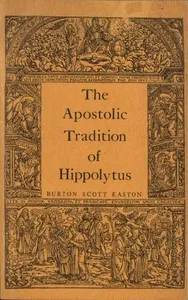
The Apostolic Tradition of Hippolytus: Translated into English with Introduction and Notes
- Language
- EN
- Format
- EPUB
- Size
- 319 KB
Description
Written in the early third century, this treatise reflects the liturgical practices and church orders of early Christianity. It is traditionally attributed to Hippolytus of Rome, an antipope active during a period of doctrinal and organizational development within the church. The text offers detailed descriptions of worship rites, ordination procedures, and communal regulations that were intended to guide Christian communities and clergy. Its content provides valuable historical insights into religious practices before the formalisation of later Christian doctrine and hierarchy.
Scholars have debated its authorship, date, and origin, with some suggesting it may be a compilation of diverse traditions rather than a single, authentic document. Rediscovered in the 19th century, the treatise has influenced understanding of early Christian liturgy and church discipline. This translation includes an introduction and notes that contextualise the work within its religious and historical setting.
Scholars have debated its authorship, date, and origin, with some suggesting it may be a compilation of diverse traditions rather than a single, authentic document. Rediscovered in the 19th century, the treatise has influenced understanding of early Christian liturgy and church discipline. This translation includes an introduction and notes that contextualise the work within its religious and historical setting.
From the opening pages
F. X. Funk . Didascalia et Constitutiones Apostolorum . Paderborn, 1905. James Cooper and Arthur John Maclean . The Testament of Our Lord. Edinburgh, 1902. Wilhelm Riedel. Die Kirchenrechtsquellen des Patriarchats Alexandrien. Leipzig, 1900. John Wordsworth. Bishop Sarapion’s Prayer-Book. London, 1899. Arthur John Maclean. The Ancient Church Orders. Cambridge, 1910. Paul Wendland. Hippolytus Werke. Dritter Band. Refutatio Omnium Haeresium. Leipzig, 1916. In the Berlin Die griechischen christlichen Schriftsteller series. The best text of the Philosophumena . Francis Legge. [Hippolytus’s] Philosophumena. London, 1921. The best English translation. Unfortunately Wendland’s critical text is ignored. 1 INTRODUCTION I. CHURCH ORDERS The early Church Orders were systematic manuals of disciplinary and liturgical rules for which the collective authority of the whole apostolate was claimed. They made their appearance in the second century, grew to considerable dimensions in the third, and reached their fullest development toward the end of the fourth century. They are sources of importance for our knowledge of the inner life of the church, and they were influential factors in the formation of the later canon law. That legislation of a fairly detailed and elaborate character should sooner or later make its appearance in Christianity was inevitable. The local congregations were made up of men and women practically isolated from the rest of the world and brought into the closest contact with one another; their church was to them almost their entire universe. If human beings anywhere are to live together under such conditions, mutual affection and forbearance—be they never so great—are not enough. Regulations, which define rights and duties in unambiguous terms, are indispensable, and these regulations are bound to increase in number and complexity as the community grows. As it happened, however, Christianity in its origins contained extraordinarily little material that could be used in forming these regulations. In theory Christians, for guidance in all matters, were to turn to Jesus Christ their Lord, whose teaching they regarded as totally divine and so the final authority in all things. But, as a matter of fact, Jesus’ concern was not with concrete and specific problems, and when asked to rule on such he brusquely 2 refused. [1] He occupied himself with ultimate moral principles, and left to individuals the task of applying these principles to the various special problems of their lives. Hence it is not at all surprising that in the apostolic and post-apostolic ages direct citation of his sayings…
FAQ
Is "The Apostolic Tradition of Hippolytus: Translated into English with Introduction and Notes" free to download?
Yes, it is free to download — no sign up needed.
What format is the file?
EPUB.
More by Antipope Hippolytus
Similar books



Reader reviews Be the first
No reviews yet. Be the first to review this book.
Write a review
Protected by reCAPTCHA.